

If you’ve spent time crafting prompt instructions for your GPT or other AI tools, you’ve probably been told to “optimize for voice.” That usually means defining tone, style, cadence, and emotional register—how your brand sounds on the page.
Not a bad start. But it’s the wrong place to start.
Because voice shapes how you sound, but not what you say.
And what you say—that content your customers, prospects, and teams will see at scale—has to come from something deeper. Something only your brand can own.
Your story.
Without it, you’re just refining style guides while sounding more and more like everyone else.
Voice is surface. Story is strategy.
Most voice prompts are fine. They’re clear, well-meaning, and… entirely interchangeable. That “confident yet friendly” fintech prompt? Works for any other fintech brand. That warm, relatable customer support script? Same deal.
So what happens?
Everyone sounds polished.
Everyone sounds professional.
Everyone sounds the same.
If that sameness is amplified across hundreds of touchpoints—emails, landing pages, chatbot scripts, ad copy—you risk eroding the very trust your voice was designed to build.
Not because your AI is writing poorly. But because it’s writing without story.
And when the message is disconnected from the mission, customers notice.
That’s when the drift starts. That’s when you hear, “This doesn’t feel like us.”
Start with story. Shape your narrative. Then apply voice.
The most effective prompt systems don’t start with a tone chart or emotion wheel. They start with the reason your brand exists.
They start with the stories that define you.
Because it’s in those stories—your founder’s leap, your customers’ wins, your team’s resilience during tough times—that your brand becomes unmistakable.
And it’s from those stories that your narrative emerges.
Not the one-line tagline on your About page. But the deeper throughline that connects your strategy, positioning, and purpose.
Get that narrative clear and suddenly your message pillars fall into place. You know what to say—and what not to.
Only then is it time to dial in voice. To layer in tone and cadence that align with who you are and what you stand for.
Here’s a better sequence: Story → Narrative → Voice
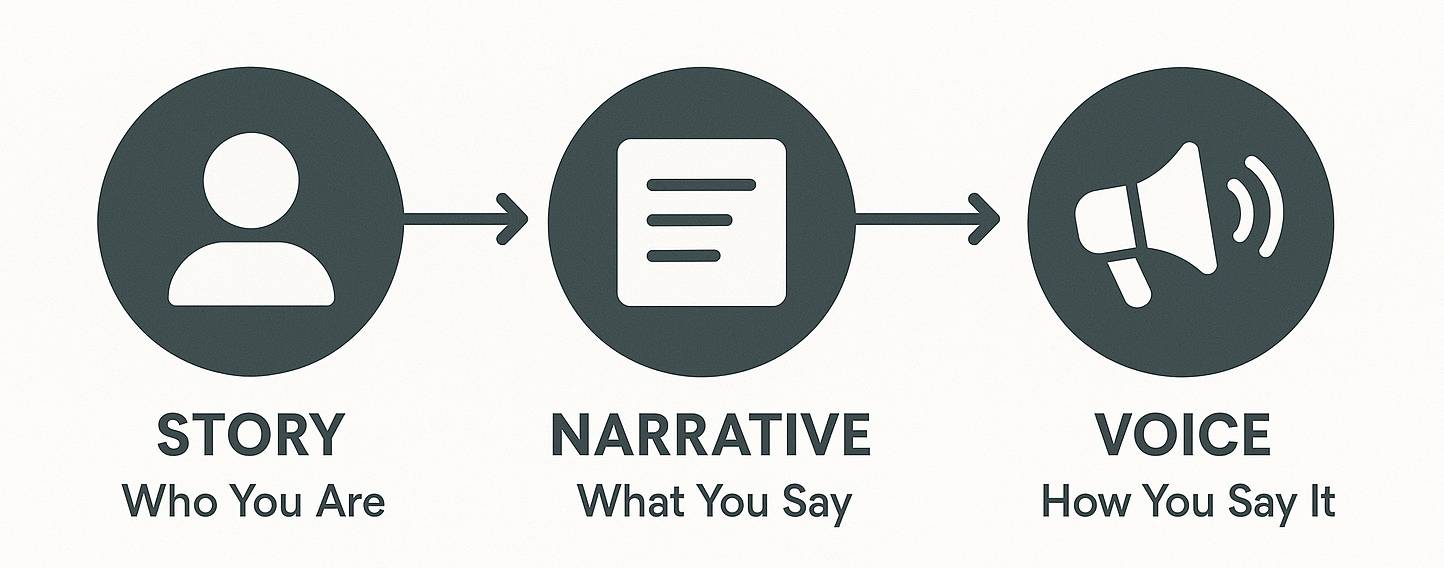
- Start with story.
What origin stories, customer stories, or mission moments define your brand? What change do you exist to create? What would your brand fight for? - Shape your narrative.
Map your message. What truths and tensions should your content return to again and again? What beliefs guide how you show up across channels? - Then—and only then—define voice.
Voice is the expression of identity. It’s how you embody your story and narrative. Not just a tone, but a filter for creative choices across your content ecosystem.
When AI enters your workflow, scale becomes real. So does the risk of sameness.
But if you ground your content in story, that scale becomes your advantage.
Story-first prompting doesn’t just make your outputs more “on brand.” It makes them more human, more resonant, more trusted.
And trust, especially in an AI-saturated world, is the thing your competitors can’t prompt their way into.
Want to sound like your brand? Start with what only your brand can say.