

Brand storytelling has become one of the most powerful tools in marketing, shaping how audiences understand, trust, and connect with brands.
From the role of values and purpose to the growing use of AI for creating content, effective storytelling has become a strategic discipline that relies on alignment, structure, and continual refinement to build meaningful engagement and lasting brand impact. But as competition for attention intensifies, CMOs are under increasing pressure to communicate clearly, consistently, and with purpose across every channel.
To find out what 1,616,900 opinions of CMOs who have successfully communicated their brand through stories in the US were, we utilized AI-driven audience profiling to synthesize insights from online discussions for a full year, ending December 9, 2025, to a high statistical confidence level. This gave us a clear view of how marketing leaders approach strategy, alignment, and execution, what effective brand storytelling looks like, and where it’s heading next.
Index
- 41% of CMOs who have successfully communicated their brand through stories are at an advanced career stage
- 50% of CMOs who have successfully communicated their brand through stories say improved long term engagement is a top motivator to invest in brand storytelling
- 36% of CMOs who have successfully communicated their brand through stories say brand purpose work is absolutely essential for identifying their brand’s core story
- 74% of CMOs who have successfully communicated their brand through stories say their brand values are a major inspiration for their brand story ideas
- 80% of CMOs who have successfully communicated their brand through stories say video content is the best format for expressing their brand story
- 78% of CMOs who have successfully communicated their brand through stories rely on regular workshops to ensure their story stays aligned across all teams
- 32% of CMOs who have successfully communicated their brand through stories say slow approvals are the main challenge they face when aligning teams around one story
- 36% of CMOs who have successfully communicated their brand through stories say story creation exercises are extremely helpful for communicating their brand story effectively
- 41% of CMOs who have successfully communicated their brand through stories say AI has supported their brand storytelling by offering improved clarity
- 14% of CMOs who have successfully communicated their brand through stories say brand storytelling has impacted their brand communication through clearer messaging
- 27% of CMOs who have successfully communicated their brand through stories use engagement growth to measure the success of their brand story
- 77% of CMOs who have successfully communicated their brand through stories use purpose-driven updates to ensure story relevance over time
- 22% of CMOs who have successfully communicated their brand through stories see influencer partnerships as a strong alternative to brand storytelling
- 21% of CMOs who have successfully communicated their brand through stories say stronger emotional connections absolutely are the future of brand storytelling
- 46% of CMOs who have successfully communicated their brand through stories are in the media industry
- 74% of CMOs who have successfully communicated their brand through stories say their current job title is senior marketing lead
- 58% of CMOs who have successfully communicated their brand through stories are currently based in Chicago
- CMOs Shaping More Connected Brand Narratives
- About the Data
How Would You Describe Your Years Of Experience In Marketing?
41% of CMOs who have successfully communicated their brand through stories are at an advanced career stage
Our audience includes individuals at different stages of their careers:
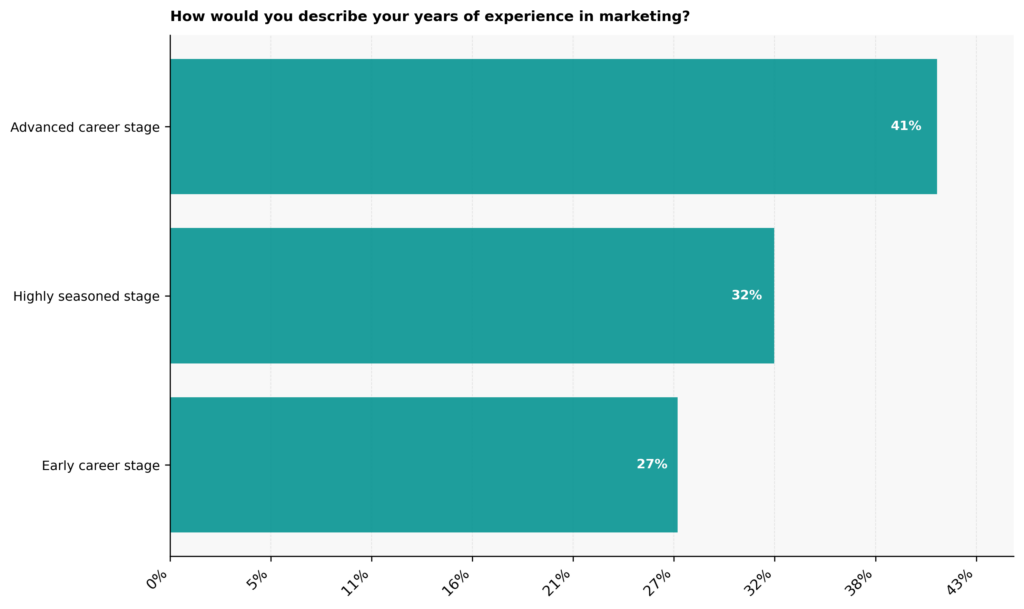
Less than half (41%) of the CMOs in our audience describe their years of marketing experience as being at an advanced career stage. The rest say they’re at a highly seasoned stage (32%) or at an early career stage (27%). However, most being in highly seasoned or advanced stages indicates they have significant experience with brand storytelling and have likely worked in various marketing or related roles.
According to the American Marketing Association, there are 2.5 million marketers in the US, or 6 million, if you count marketing-adjacent roles such as fundraising, graphic design, public relations, sales, and user experience.
What Motivates You To Invest In Brand Storytelling?
50% of CMOs who have successfully communicated their brand through stories say improved long-term engagement is a top motivator to invest in brand storytelling
Different factors motivate brand storytelling investment:
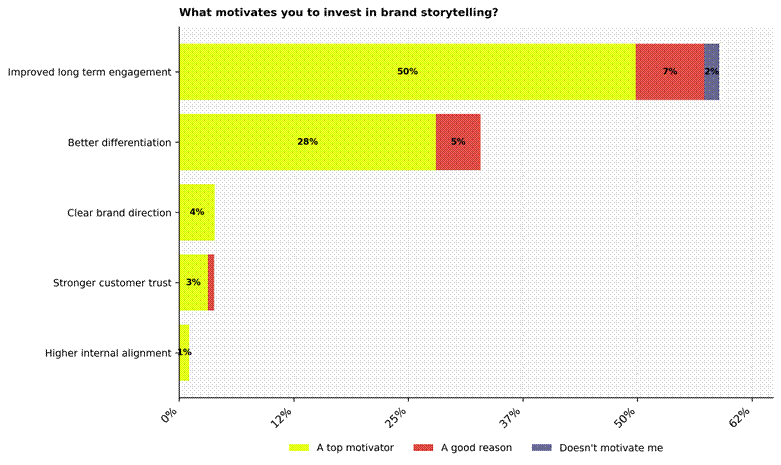
Not all brand storytelling investments are made with the same motivations. For 50% of CMOs who have successfully communicated their brand through stories, improving long-term engagement is a top motivation, although 7% regard this as a good reason, and 2% say it doesn’t motivate them. Evidently, more than half of our audience understands the value of long-term engagement and its connection to brand loyalty.
Among those who mention better differentiation, this is either a top motivator (28%) or a good reason (5%), which implies these CMOs know that people have a natural tendency to remember stories and that, by remembering particular brand stories, customers or potential customers are better able to tell one brand apart from another.
Clear brand direction is a top motivator for 4% of our audience, suggesting storytelling is an integral part of communicating this to customers, while stronger customer trust is a top motivator for 3%. Only 1% say higher internal alignment is their top motivator.
Although top motivations for investing in brand storytelling varied, almost all the motivations expressed align with the findings of a study on the impact of storytelling on the consumer brand experience. The study found that a well-crafted story creates positive brand associations, increases consumers’ willingness to pay for it, and reduces confusion about the brand, its products, or services
What Helps You Identify The Core Story Of Your Brand?
36% of CMOs who have successfully communicated their brand through stories say brand purpose work is absolutely essential for identifying their brand’s core story
There are different approaches to identifying the core story of brands:
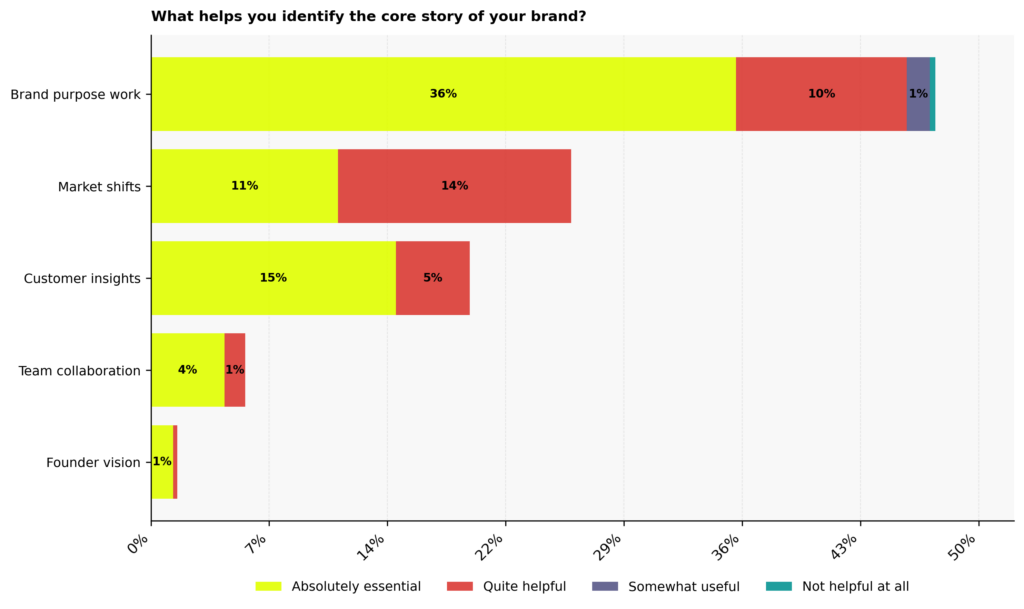
It’s clear there’s no single way that CMOs identify their brand’s core story. While 36% say brand purpose work is absolutely essential for this, 10% regard this approach as quite helpful, and 1% think it’s only somewhat helpful. This is surprising, as a significant part of brand purpose work is the defining of an organization’s central reason for existing and the impact it wants to make. This is effectively the brand’s core story and should guide all business decisions.
Among those in our audience who mentioned market shifts, 11% say these are absolutely essential, although 14% say they’re quite helpful. This suggests these brands might have focused on identifying their core story in response to market shifts or that these shifts forced them to rethink or fine-tune their stories. 15% say customer insights are absolutely essential, while 5% find them quite helpful.
It’s also surprising that relatively few CMOs who have successfully communicated their brand through stories use customer insights when identifying their brand’s core story. According to the Ipsos Global Trends 2021 report, consumers prefer brands whose values and purpose align with their own values. Customer insights can shed light on their values, enabling brands to communicate similar values more effectively in their storytelling.
As for the rest of our audience, 4% say team collaboration is absolutely essential for identifying their brand’s core story, while 1% say this is quite helpful. Only 1% say the founder’s vision is absolutely essential.
What Inspires Your Brand Story Ideas?
74% of CMOs who have successfully communicated their brand through stories say their brand values are a major inspiration for their brand story ideas
Brand story inspiration comes from one main source:
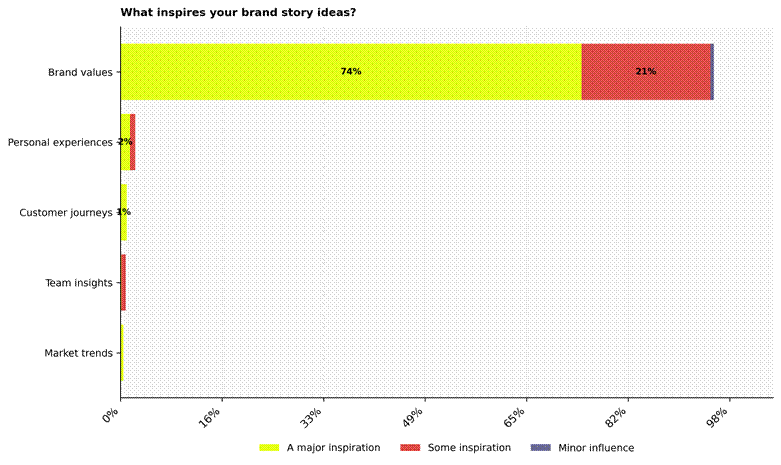
Inspiration for brand story ideas can come from a variety of sources. However, for most CMOs, their brand values provide inspiration, though the extent to which they inspire varies. 74% say brand values are a major inspiration, while 21% say they provide some inspiration. This ties in with the report about consumers preferring brands whose values align with their own, mentioned above. There’s no getting away from the fact that brand values are important, as these sets of beliefs usually inform organizational structure, leaders’ decisions, and workplace philosophy.
Our audience also mentions personal experiences as a major source of inspiration (2%), revealing that they’ve had experiences they believe encapsulate various aspects of the brand’s story or values that customers can relate to. Customer journeys are also a major source of inspiration for 1% of CMOs.
What Format Helps You Express Your Brand Story Best?
80% of CMOs who have successfully communicated their brand through stories say video content is the best format for expressing their brand story
Not everyone agrees that video is the best format:
The overwhelming majority (80%) of CMOs who have successfully communicated their brand through stories say video content is the best format for expressing their brand story. While 9% don’t entirely agree with them, this segment does say video is a good option. The majority of our audience is in sync with other marketers in the US – according to Hubspot, 93% of marketers consider video a crucial part of their overall strategy.
The rest of our audience prefers written narratives, with 8% saying this is the best format and 3% saying it’s a good option, indicating that brands’ customers prefer written narratives to video.
How Do You Ensure Your Story Stays Aligned Across All Teams?
78% of CMOs who have successfully communicated their brand through stories rely on regular workshops to ensure their story stays aligned across all teams
Different approaches are used for ensuring story alignment across teams:
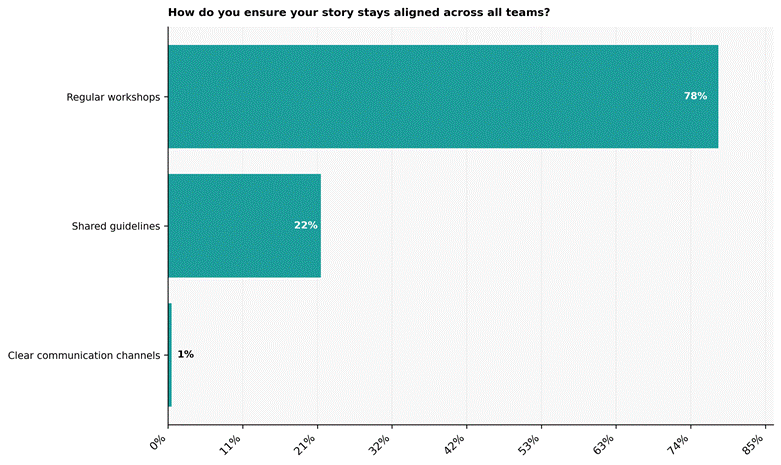
Brand storytelling suffers when the story is not aligned across all teams, so CMOs must ensure alignment to make their storytelling effective. 78% of CMOs say they organize regular workshops to ensure story alignment across all teams, likely because they know from experience this approach works.
In contrast, 22% say they rely on shared guidelines, while 1% say they use clear communication channels to ensure alignment. This suggests these CMOs have seen good results from these methods.
What Challenge Do You Face Most When Aligning Teams Around One Story?
32% of CMOs who have successfully communicated their brand through stories say slow approvals are the main challenge they face when aligning teams around one story
CMOs face a range of challenges:
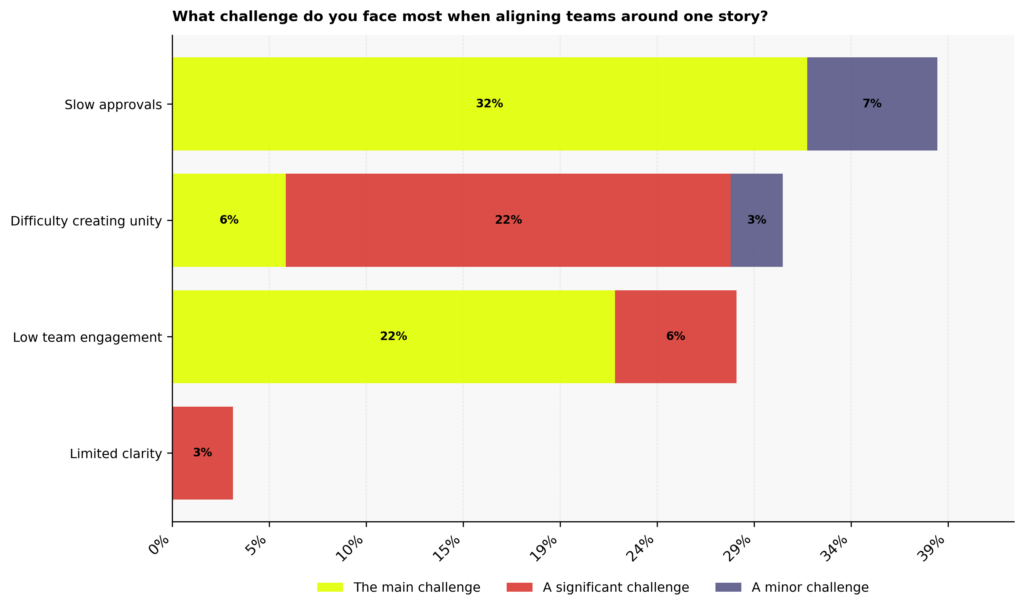
Aligning teams around a brand story can be challenging, and the biggest challenges depend on who you ask. 32% of CMOs who have successfully communicated their brand through stories say slow approvals are their main challenge, although this is only a minor challenge for 7%. This could be due to some CMOs’ efforts being hampered by teams not being aligned during various stages of the process.
For 6%, the main challenge is difficulty in creating unity. This is a significant challenge for 22% and a minor challenge for 3%, which implies some CMOs’ teams have strong conflicting opinions. Another 22% say their main challenge is low team engagement, while 6% recognize this as a significant challenge. 3% say limited clarity is a significant challenge when aligning teams around a brand story.
While each of these challenges is different, they all boil down to communication. Whether communication is slow, unclear, disjointed, or haphazard, it hinders efficiency, prevents tasks from being completed properly, and can negatively impact campaign timelines. With this in mind, it’s easy to see why there’s a strong preference for regular workshops, as mentioned above.
What Type Of Training Has Helped You Communicate Your Brand Story Effectively?
36% of CMOs who have successfully communicated their brand through stories say story creation exercises are extremely helpful for communicating their brand story effectively
Various types of training ensure effective brand story communication:
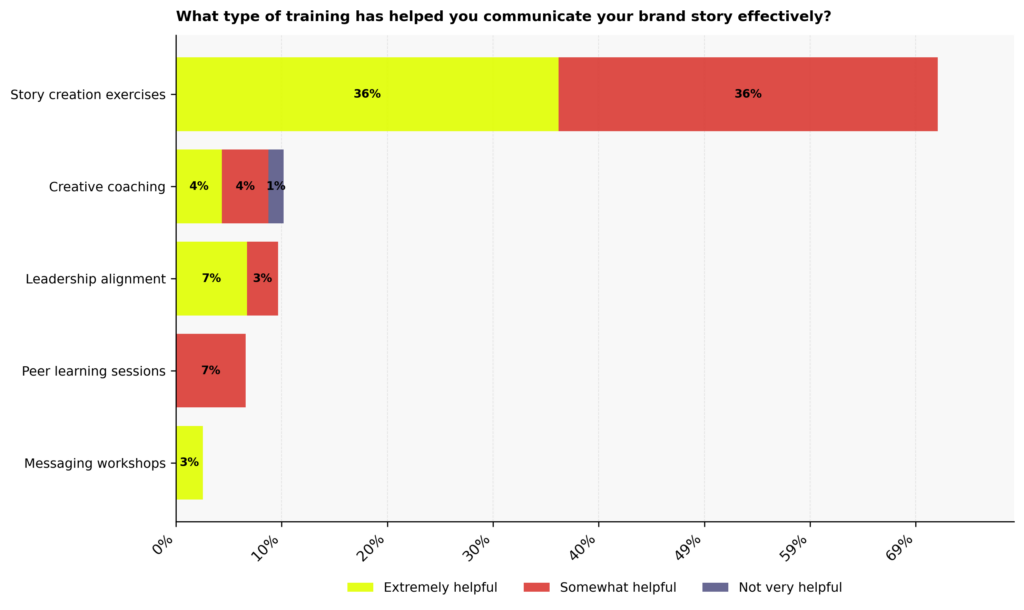
The CMOs in our audience have tried various types of training in an effort to communicate their brand stories more effectively. 36% say story creation exercises have been extremely helpful, while another 36% partially agreed, saying they are somewhat helpful. Evidently, both groups had good results, even if one segment’s results were better. Some tried creative coaching, although opinions about this ranged from extremely helpful (4%)to somewhat helpful (4%) and not very helpful (1%).
7% say they found leadership alignment extremely helpful, while only 3% found this type of training somewhat helpful, indicating that leadership in their organization doesn’t have much say in brand storytelling initiatives. 7% say peer learning sessions were somewhat helpful, while 3% say messaging workshops are extremely helpful, again highlighting the importance of effective communication.
Some of our findings overlap with advice from Gartner’s peer community on cost-effective go-to-brand exercises for creating a consistent, compelling brand story across activations. Among the suggested exercises are developing a unique brand identity and guide, as well as resources and training to reinforce the brand story.
How Has AI Supported Your Brand Storytelling?
41% of CMOs who have successfully communicated their brand through stories say AI has supported their brand storytelling by offering improved clarity
AI supports brand storytelling in various ways:
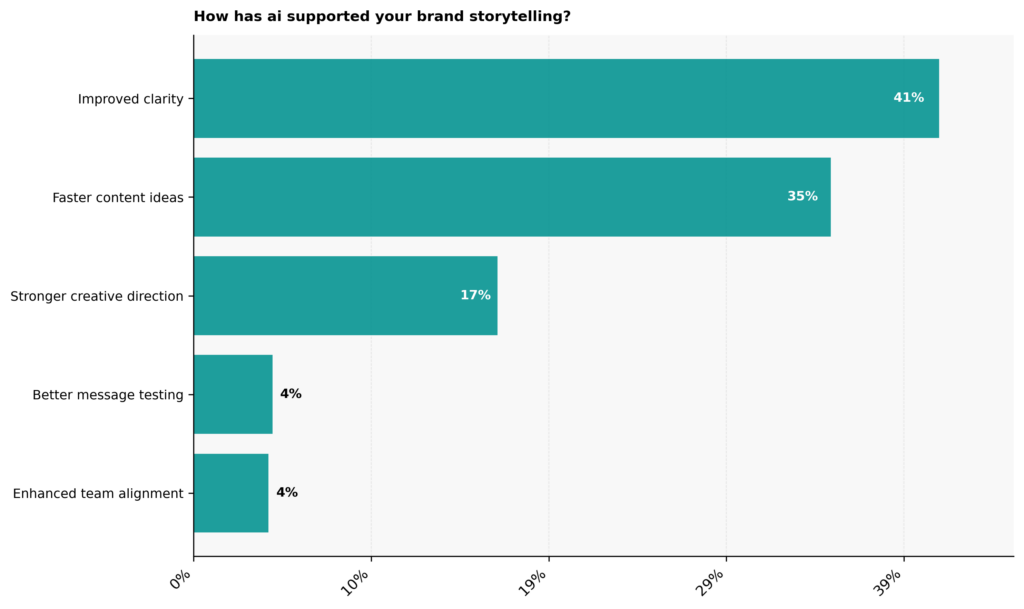
The ways that AI has supported our audience’s brand storytelling align with Adobe’s report. Slightly less than half (41%) of our audience of CMOs say they have benefited from AI providing improved clarity, suggesting they’ve used this technology to provide feedback or tweak their stories. 35% say AI offers faster content ideas, which is a major advantage and time-saver.
For 17%, AI has supported a stronger creative direction, while 4% say AI has enabled better message testing. Another 4% say this technology enhances team alignment.
What Impact Has Brand Storytelling Had On Your Brand Communication?
14% of CMOs who have successfully communicated their brand through stories say brand storytelling has impacted their brand communication through clearer messaging
Brand storytelling impacts brand communication in different ways:
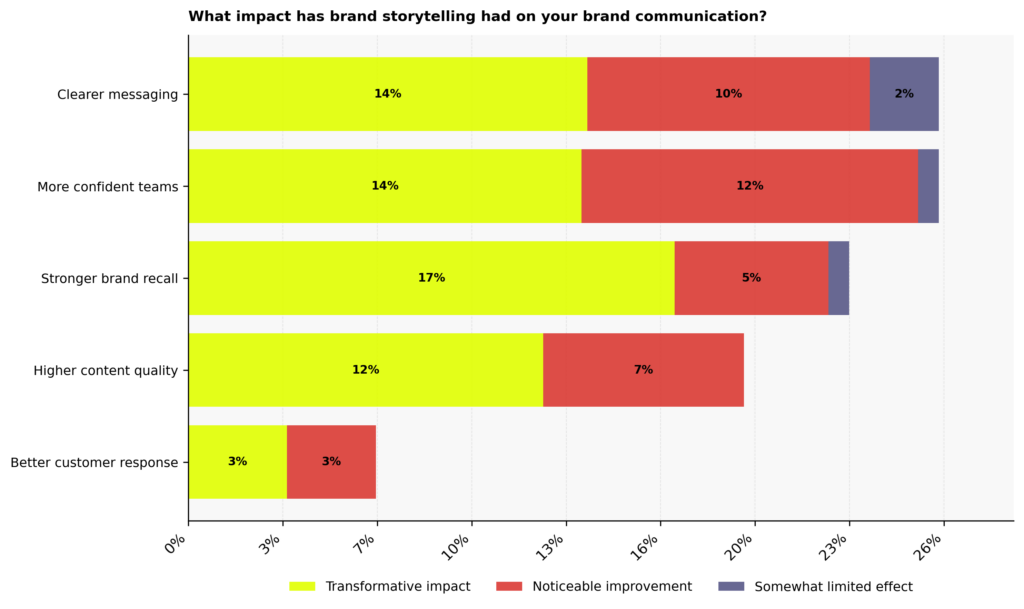
Brand storytelling doesn’t impact brand communication for different organizations in the same way. 14% of CMOs say brand storytelling has had a transformative impact through clearer messaging. However, others weren’t as enthusiastic, with 10% saying the impact has been a noticeable improvement and 2% saying the effect was somewhat limited. This suggests these segments struggled with unclear or confusing messaging in the past.
Another 14% say they see storytelling’s transformative impact in their teams being more confident, while 12% say they saw a noticeable improvement in this regard. Clearly, teams lacked confidence, which may have been due to negative feedback from coworkers or customers. For 17%, the transformative impact has been in stronger brand recall. 5% say they’ve seen a noticeable improvement in brand recall. 12% say their brand storytelling has a transformative impact, and 5% say it makes a noticeable improvement to the quality of their content. A minority mentions better customer response, with 3% saying the impact on this has been transformative, and another 3% saying storytelling made a noticeable improvement.
Mentions of clearer messaging, stronger brand recall, and better customer response across various audience segments align with the findings of a study on the Role of Storytelling in Enhancing Consumer Engagement and Strengthening Brand Awareness. According to the study, visually compelling storytelling can increase consumer engagement. The study also found that narratives should be tailored to different platforms, as digital media platforms can profoundly moderate the effectiveness of brand stories. There’s also a positive link between storytelling strategies and consumer trust, particularly when brand stories incorporate real-life success stories and testimonials.
How Do You Measure The Success Of Your Brand Story?
27% of CMOs who have successfully communicated their brand through stories use engagement growth to measure the success of their brand story
CMOs have different approaches to measuring brand story success:
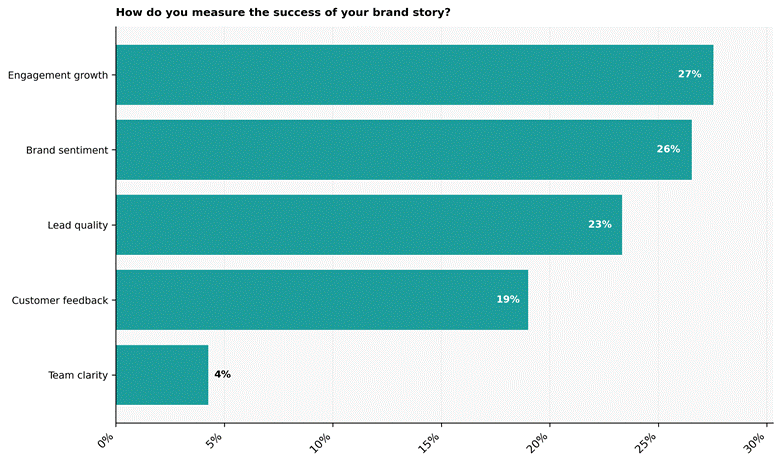
As with all campaigns and activations, the success of those involving brand storytelling must be measured. As our insights reveal, this can be done in several different ways. 27% of CMOs who have successfully communicated their brand through stories say they use engagement growth to do this.
26% use brand sentiment to measure brand story success, while 23% focus on lead quality as a measure of success, and 19% rely on customer feedback. Only 4% say they use team clarity, suggesting brand storytelling plays a role in internal communications and training.
How Do You Ensure Your Story Remains Relevant Over Time?
77% of CMOs who have successfully communicated their brand through stories use purpose-driven updates to ensure story relevance over time
CMOs have different ways of ensuring their story remains relevant over time:
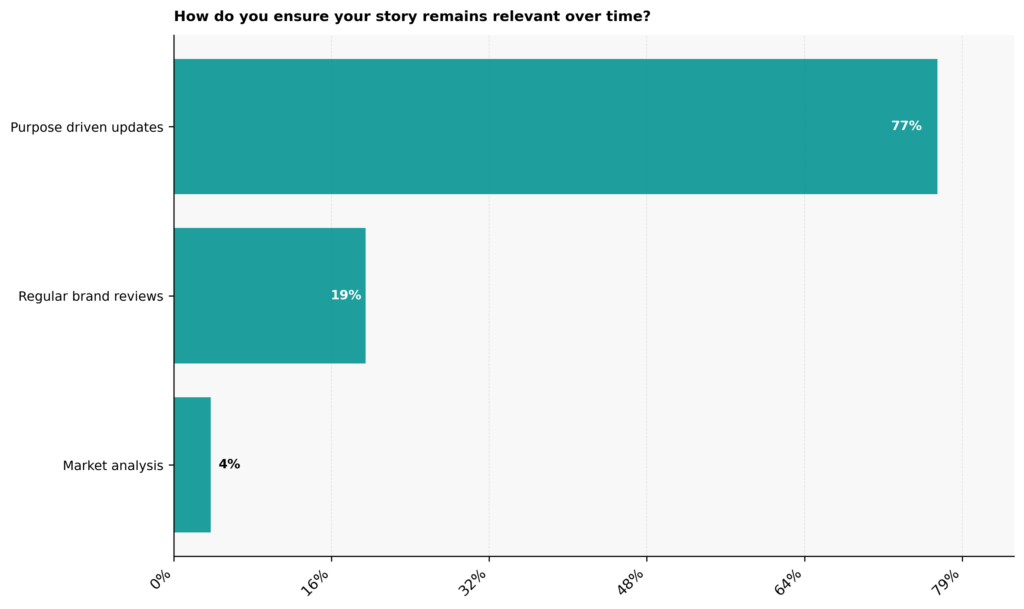
Marketers who want to tell brand stories that really connect with customers need to know their audience and remain relevant over time. The majority (77%) of CMOs say they use purpose-driven updates to ensure the continued relevance of their story, indicating that the story is updated to reflect brand evolution, market trends, or what they’ve learned from their preferred success metrics. The rest of our audience have different approaches, with 19% saying they use regular brand reviews and 4% saying they rely on market analysis.
While the approaches of the latter two segments have their merits, the majority of our audience is on to something. Purpose-driven updates require a strong knowledge of brand identity and the brand’s target audience.
What Do You See As The Alternative To Brand Storytelling?
22% of CMOs who have successfully communicated their brand through stories see influencer partnerships as a strong alternative to brand storytelling
Opinions on alternatives to brand stories differ greatly:
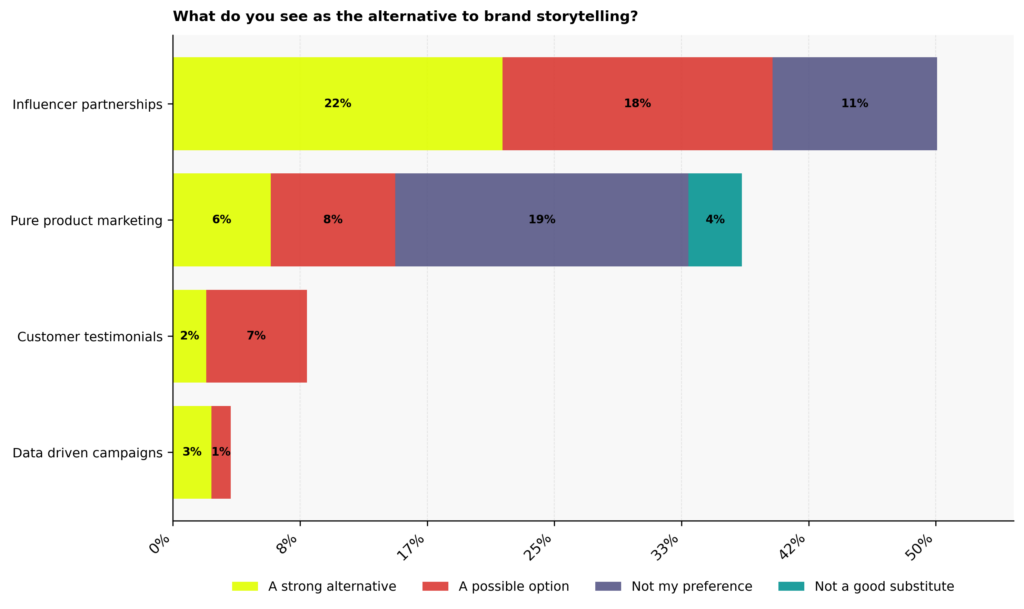
The CMOs in our audience have different ideas regarding alternatives to brand storytelling. 22% say influencer partnerships are a strong alternative, although this is only a possible option for 18%, and 11% say this is not their preference. The fact that influencer partnerships attracted the most opinions aligns with the industry’s massive growth, with creator revenue from sponsored content expected to exceed $10 billion in 2025.
Some in our audience mention pure product marketing as an alternative. However, only 6% say this is a strong alternative, while 8% say it’s a possible option, 19% say it’s not their preference, and 4% say it’s not a good substitute. Based on these opinions, most CMOs view pure product marketing as a step backward, recognizing that it is less effective than brand storytelling or other storytelling alternatives.
Customer testimonials are a strong alternative for 2% and a possible option for 7%, which touches on various storytelling elements mentioned above, authenticity, relatability, and real-life success stories. The last storytelling alternative mentioned by our audience is data-driven campaigns, with 3% saying this is a strong alternative and 1% saying it’s a possible option.
What Do You See As The Future Of Brand Storytelling?
21% of CMOs who have successfully communicated their brand through stories say stronger emotional connections absolutely are the future of brand storytelling
Opinions on brand storytelling’s future are broad:
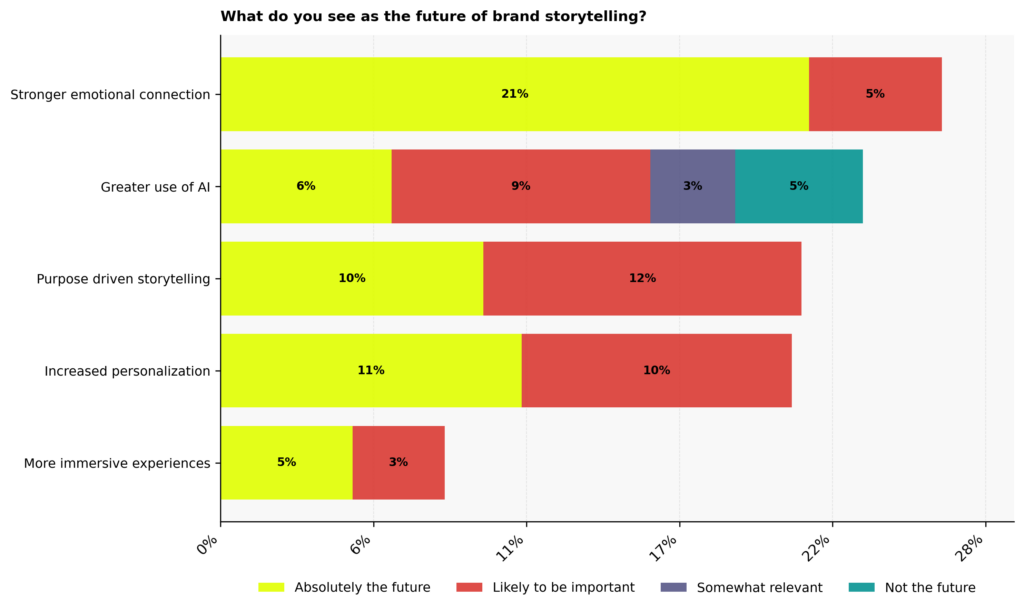
CMOs who have successfully communicated their brand through stories have incredibly diverse perspectives on the future of brand storytelling – so much so that no single idea enjoyed clear dominance. For 21%, stronger emotional connections absolutely are the future, although 5% disagree somewhat, saying this is likely to be important. Neither of these audience segments is incorrect, as brand storytelling plays a powerful role in creating emotional connections between customers and the brand.
A study on this role highlights how brand storytelling allows organizations to create narratives that express their values, identity, and purpose to evoke joy, nostalgia, and other emotions, rather than seeing them focus on product features or benefits. This approach helps humanize brands, making them more relatable and building a sense of community for customers. Storytelling also helps brands stand out from others that rely on traditional adverts.
6% of our audience say the future of brand storytelling absolutely will include greater use of AI, while 9% say AI use is likely to be important. However, 3% say this is only somewhat relevant, and 5% disagree outright, saying this is not the future. This ties in with our audience highlighting their use of AI in supportive roles rather than relying on it solely for storytelling.
Purpose-driven storytelling also received mentions, with 10% saying this absolutely is the future and 12% saying it’s likely to be important. 11% say increased personalization absolutely is the future, while 10% say this is likely to be important. This ties in with the importance of brands knowing their audiences and, again, with using AI to support brand storytelling. According to 5% of CMOs, more immersive experiences absolutely are the future, although 3% disagree slightly, saying that they’re only likely to be important.
What Industry Are You In?
46% of CMOs who have successfully communicated their brand through stories are in the media industry
Our audience represents a wide range of industries in the US:
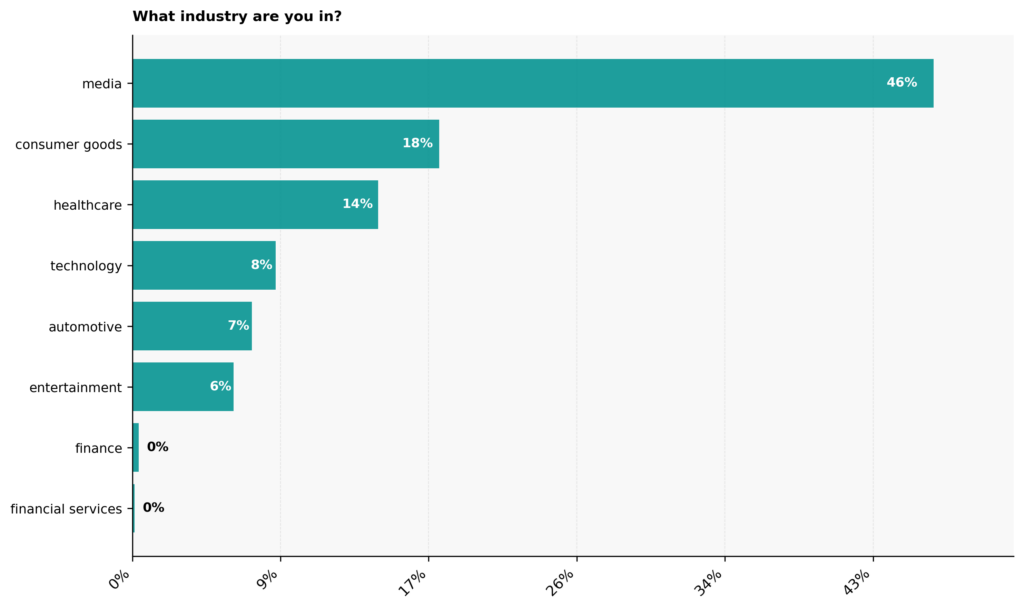
Almost half our audience (46%) works in media, an industry in which storytelling is front and center. The push to improve storytelling, particularly brand storytelling, in this industry may be a result of the continued decline in media subscriptions. A Variety article reveals how, in 2014, 19 cable networks surpassed more than 1 million prime-time viewers. By 2023, only three cable networks attracted an average audience of more than 1 million.
As for the rest of our audience, 18% say they work in consumer goods, and 14% in healthcare. 8% say they work in technology, 7% in automotive, and 6% in entertainment.
What Is Your Current Job Title?
74% of CMOs who have successfully communicated their brand through stories say their current job title is senior marketing lead
Our audience works in different roles in their respective organizations:
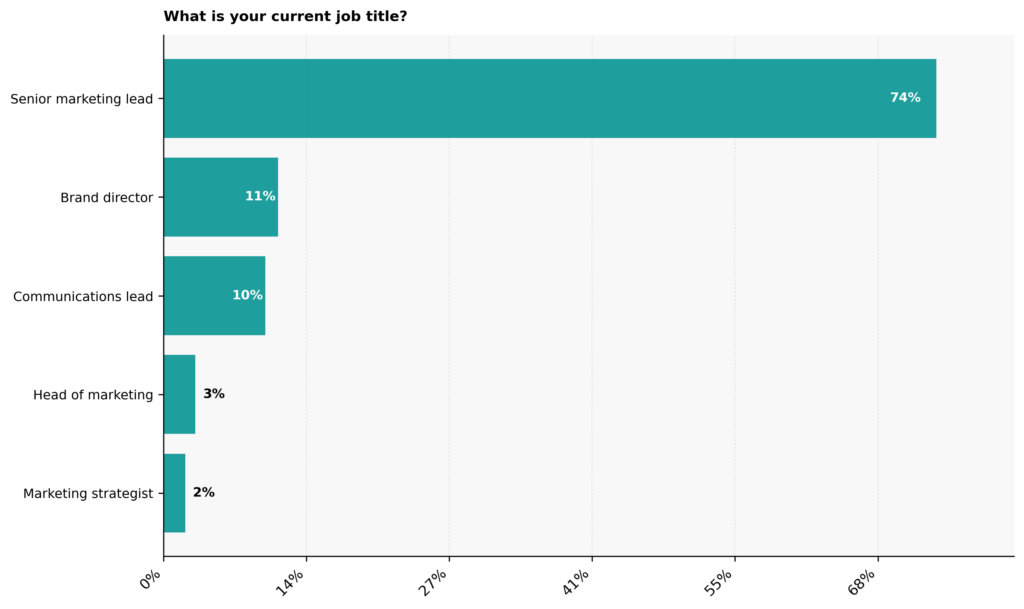
While the CMOs in our audience work in different roles, the overwhelming majority (74%) say senior marketing lead is their current job title. 11% say they’re brand directors, 10% are communications leads, and 3% say they’re head of marketing. Only 2% say they’re marketing strategists.
What City Are You Currently Based In?
58% of CMOs who have successfully communicated their brand through stories are currently based in Chicago
The CMOs in our audience are based in various major US cities:
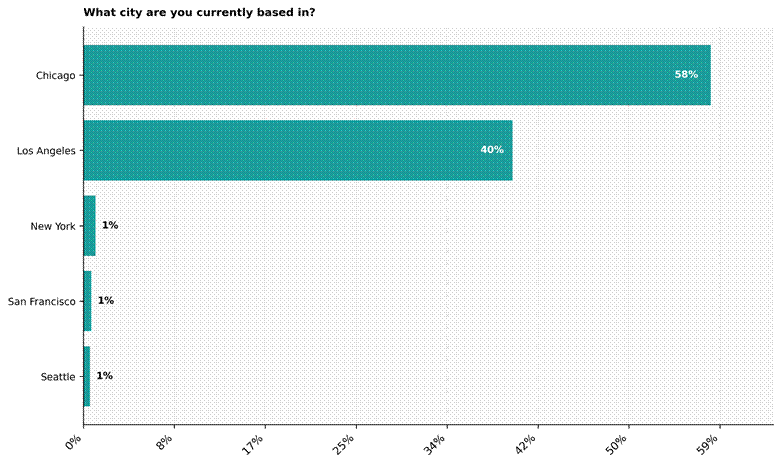
More than half (58%) of our audience is currently based in Chicago. This makes sense, as the Windy City is a long-standing marketing hub, boasting the third-largest base of marketing professionals after the Big Apple and the City of Angels, which were also mentioned by our audience. 40% of CMOs are currently based in Los Angeles, while 1% are in New York. Another 1% is based in San Francisco, and yet another 1% in Seattle, revealing that although there is a minor presence, the majority are in Chicago and LA.
CMOs Shaping More Connected Brand Narratives
Combined, these findings paint a clear picture of how brand storytelling is being shaped in the US today. Successful CMOs are grounding their stories in purpose and values, prioritizing emotional connection, and using video, workshops, and training to keep teams aligned around a shared narrative.
While challenges such as slow approvals and internal alignment remain, the emphasis on clarity, consistency, and long-term engagement shows that storytelling is no longer a creative add-on, but a strategic discipline.
As brands look ahead, the future of storytelling will be defined by stronger emotional resonance, the use of AI as a support tool, and a continued focus on relevance, authenticity, and human connection.
About The Data
Sourced using Artios from an independent sample of 1,616,900 opinions of CMOs that have successfully communicated their brand through stories in the US across X, Quora, Reddit, Bluesky, TikTok, and Threads. Responses are collected within a 95% confidence interval and 5% margin of error. Results are derived from what people describe online, from opinions expressed, and not actual questions answered by people in the sample.